






Ministry of Justice £500 Mediation Voucher Scheme
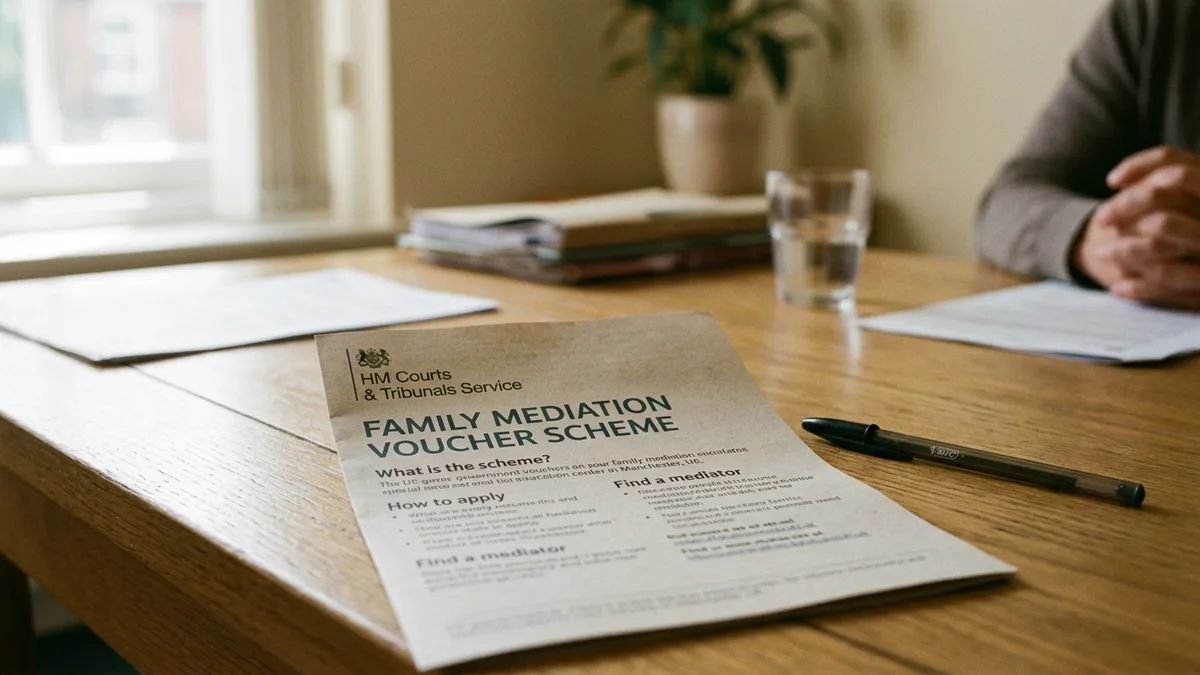
To support separating parents in reaching amicable arrangements without resorting to stressful court battles, the UK Ministry of Justice provides a £500 contribution towards joint mediation fees for eligible cases involving child arrangements.
Who is Eligible for the £500 Voucher?

- Any dispute concerning arrangements for children, including living routines, contact schedules, and school holiday rotas.
- Disputes involving combined financial settlements and child arrangements.
- The voucher is non-means-tested: eligibility depends entirely on the nature of the dispute rather than your personal income.
How Mediation Direct Claims the Voucher for You

You do not need to fill out complex government grant applications. Mediation Direct is an authorised scheme participant. Your mediator will verify your eligibility during your initial MIAM consultation and submit the voucher claim directly to the Family Mediation Council on your behalf.
Legal Aid for Family Mediation

Legal Aid remains active and fully accessible for family mediation. If you receive qualifying state benefits or have low disposable income, your individual MIAM and all subsequent joint mediation sessions will be 100% publicly funded. In addition, if one party qualifies for Legal Aid, the other party receives their MIAM and first joint session free of charge.
Two different schemes, frequently confused

The Family Mediation Voucher Scheme and legal aid for family mediation are separate, they are funded differently and they qualify on entirely different criteria. People regularly assume they are the same thing, conclude they would not qualify, and pay in full for something that was available to them.
The voucher is a fixed contribution of up to five hundred pounds toward mediation about arrangements for a child. It is not means tested. Household income, savings and property are irrelevant to it.
Legal aid is means tested on income and capital, it is not limited to child arrangements, and where you qualify it can cover the process in full rather than contributing to it.
The voucher, in detail
It applies to the joint mediation sessions rather than to the MIAM, and it is a contribution: where mediation costs more than the voucher, you pay the balance.
It is one voucher per family and it is used once. A family with substantial assets qualifies on identical terms to one without, because there is no financial assessment at all.
Cases in scope are those concerning where a child lives, the time a child spends with each parent, a specific issue such as schooling or medical treatment, or a prohibited step. A case dealing with both a child arrangements issue and a financial issue is also in scope, because the child element brings the whole mediation within the scheme. That last point is worth knowing: couples resolving the house and the children together frequently assume the scheme is for child-only cases and never ask.
Out of scope: a financial case with no child arrangements element, and a dispute purely between adults such as one between former cohabitants where no child is involved.
How the voucher is claimed
You do not apply and you do not receive money. The mediator confirms eligibility, applies on your behalf, and deducts the contribution from the fees. The funder pays the mediator directly, so there is nothing to reclaim and no reimbursement to chase.
Only mediators authorised by the Family Mediation Council can access the scheme, which in practice means an FMC registered mediator at an authorised provider. A mediator who is not registered cannot offer it, however capable they are, and there is no route to claiming it afterwards. It is the first question worth asking any service.
How the deduction is split between two people is a matter for agreement. Splitting it equally and applying it entirely to the lower earner's fees are both common. Agree it at the outset rather than after the first invoice.
Legal aid, in detail
Eligibility is assessed on gross and disposable income, on capital including savings and property equity, and on the benefits you receive. Certain benefits passport you through the income assessment automatically.
Where you qualify, legal aid covers the MIAM and the mediation sessions. It also covers a defined amount of legal advice alongside the mediation, and the legal work required to convert the outcome into a consent order. That last element is significant, because for a privately funded case the consent order is a separate solicitor cost.
The point most often missed: where one party qualifies for legal aid, the MIAM is generally free for both. If you believe your former partner may qualify, that is worth establishing before either of you pays for anything.
You cannot use legal aid and the voucher for the same sessions. Where you qualify for legal aid it is usually the better route, and a mediator will tell you which applies.
Establishing which applies to you
A mediator carries out the assessment as part of the enquiry and the MIAM. You will be asked for evidence of income, which for an employed person means recent payslips, and evidence of benefits where you receive them. It is a short process and it is done before any fee is charged.
If you are unsure whether you would qualify, ask rather than assuming. The assessment costs nothing and the thresholds are not always where people expect them to be.
What neither scheme covers
For privately funded cases, the voucher does not cover the MIAM, the drafting of the consent order, or independent legal advice. Knowing the shape of what remains means the figure you budget is the real one rather than the session fee minus the voucher.
Neither scheme covers a second mediation later, because the voucher is used once per family and legal aid is assessed against your circumstances at the time.
If neither applies
Most services charge per session rather than taking a block fee, which means you are never committed further than the next meeting, and many offer staged payment. Ask about both.
It is also worth setting the private cost against the alternative honestly. A mediated financial settlement, including the consent order that makes it binding, commonly comes to a few thousand pounds shared between two people. Contested financial proceedings commonly run into five figures per party. The comparison is not close, and it holds whether or not any funding applies.
The scheme is not permanent
The voucher has been extended more than once since it was introduced and it operates within a funded allocation rather than as a statutory entitlement. A scheme that depends on a departmental budget can be changed or closed.
Check current availability with an authorised mediator when you enquire rather than relying on what a page said at some point in the past. Any registered service will tell you where the scheme stands that week.

 Face to face sessions
 Online and remote mediation
 Evening and weekend appointments